Motion Style Slider
Continuous style-intensity control for human motion diffusion.
Motion Style Slider
Endpoint-Supervised Continuous Style Control for Human Motion Diffusion
1Institute of Science Tokyo 2The University of Tokyo 3Cygames, Inc.
*The work was partially done during an internship at Cygames, Inc.
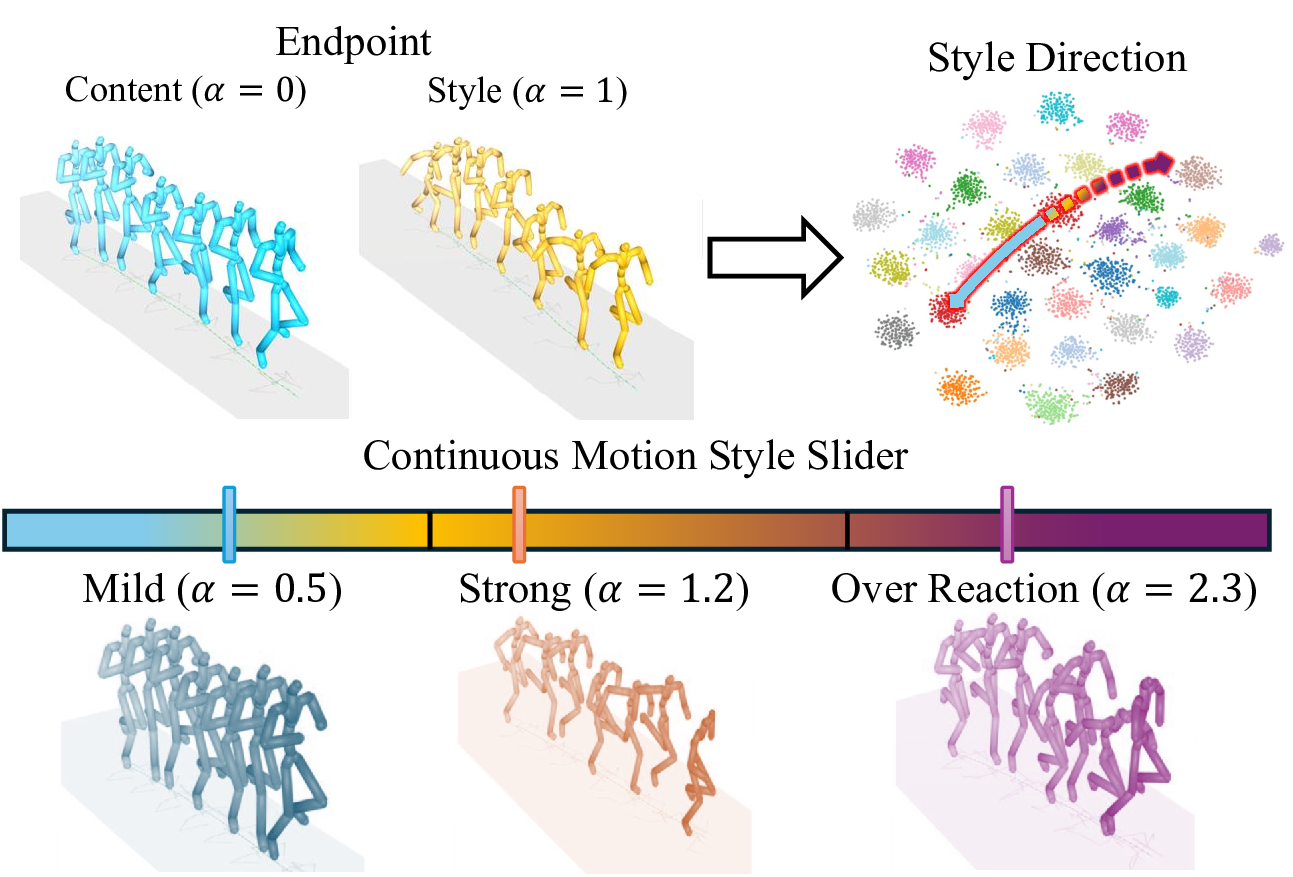
A slider for motion style
Motion Style Slider is a motion-to-motion diffusion framework for fine-grained control of style intensity. Given a content motion and a stylized endpoint, the model generates a continuous family of motions controlled by a scalar value, from neutral behavior through the target style and into stronger out-of-range reactions. The control is relative and monotonic, matching the way artists and directors naturally ask for a motion to be “a little more” or “a little less” expressive.
How it works
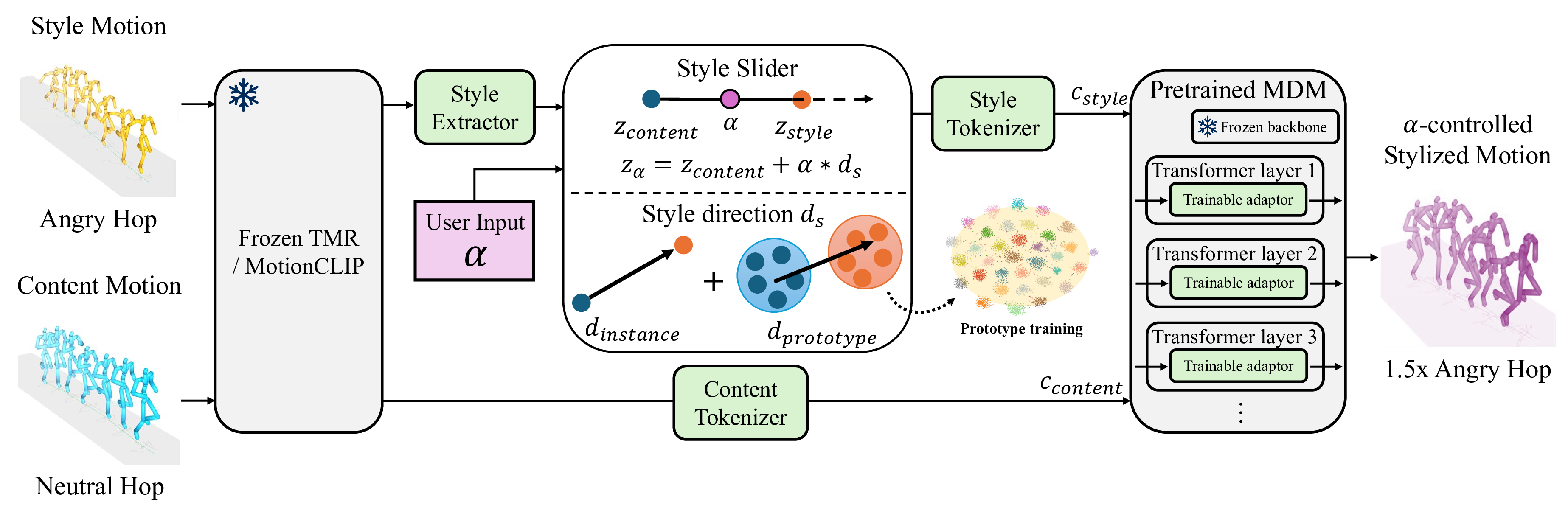
We represent the change from content motion to style motion as a direction in a learned motion-style embedding space. Moving along that direction with intensity \(\alpha\) creates the style condition for a pretrained motion diffusion denoiser. Diffusion training is combined with latent intensity regularization to encourage smooth, ordered changes while preserving the original action.
Qualitative results
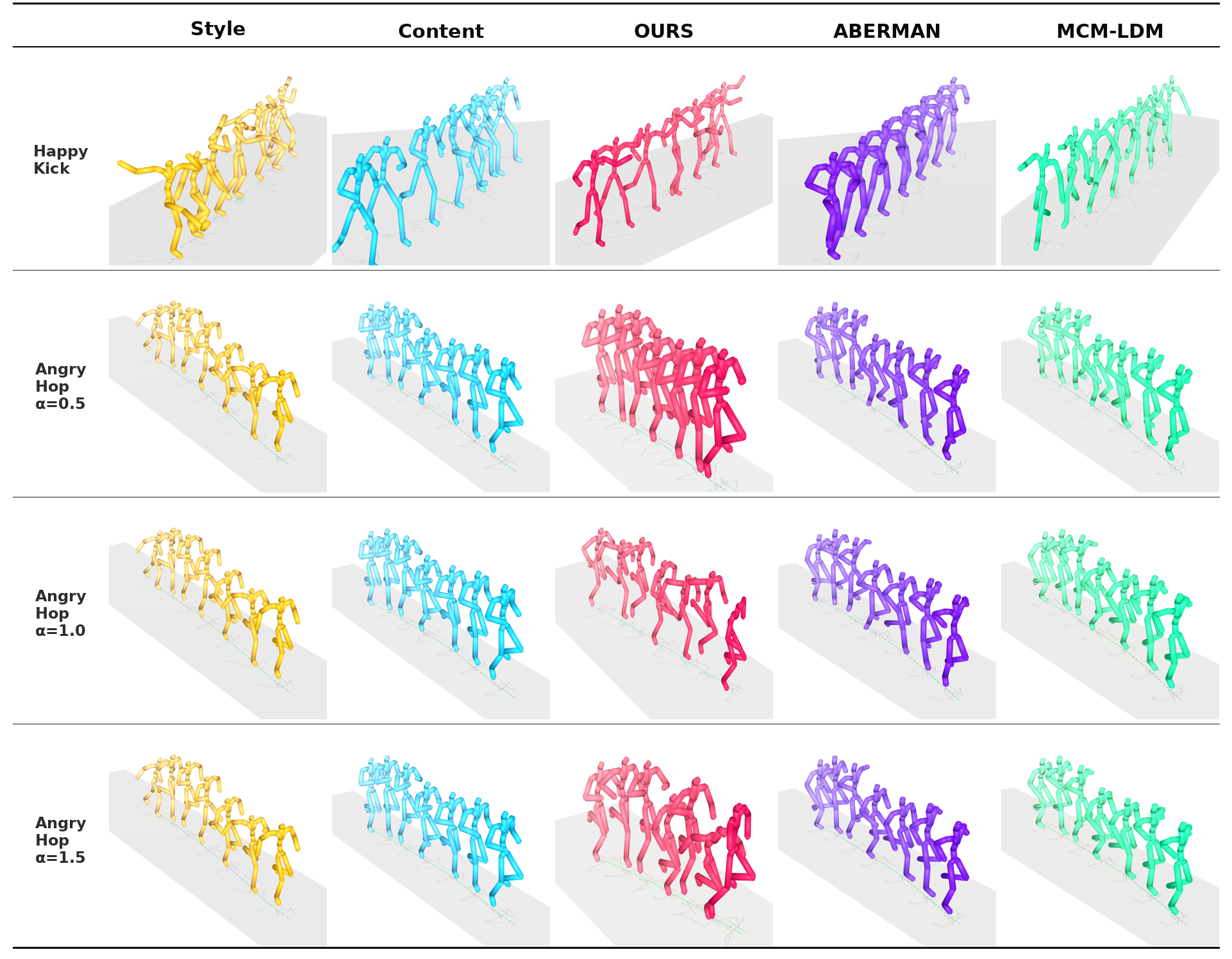
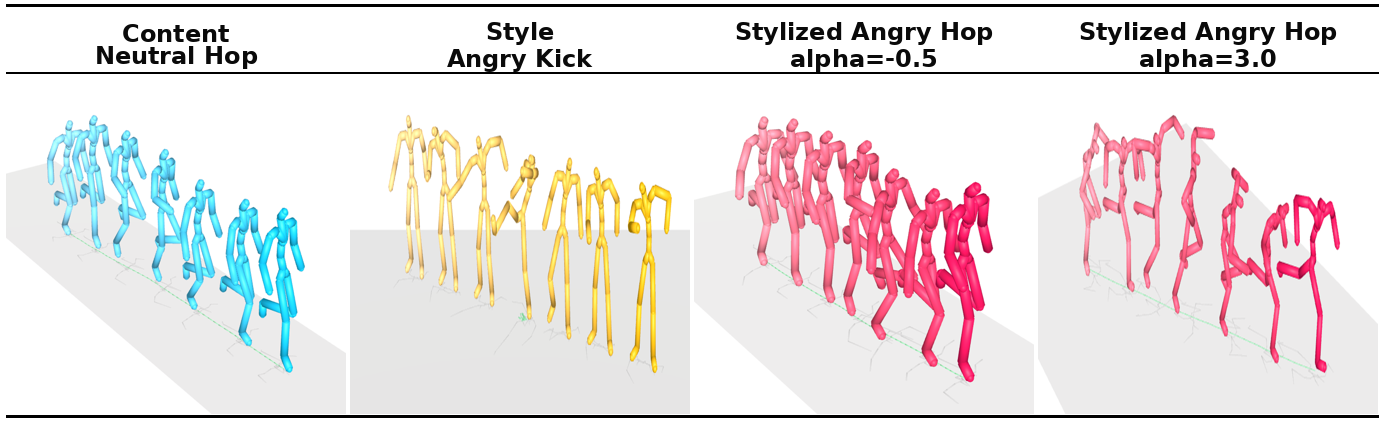
Across several motion-style datasets, the method aims to preserve the source action while changing expression predictably as the slider moves. Evaluation covers realism, content preservation, monotonicity, interpolation, and extrapolation to newly captured over-reaction targets.
Citation
@inproceedings{liao2026motionstyleslider,
  title     = {Motion Style Slider: Endpoint-Supervised Continuous
               Style Control for Human Motion Diffusion},
  author    = {Liao, Chen-Chieh and Peng, Yichen and Cai, Yiyi and
               Ono, Yûi and Hanaoka, Hiroki and Wu, Erwin and
               Koike, Hideki and Kurabayashi, Shuichi},
  editor    = {Favaro, Paolo and Kukelova, Zuzana and Maki, Atsuto and
               Rohrbach, Anna and Schindler, Konrad and Tombari, Federico},
  booktitle = {Computer Vision -- ECCV 2026: 19th European Conference,
               Malmo, Sweden, September 8--12, 2026, Proceedings, Part XXVI},
  series    = {Lecture Notes in Computer Science},
  volume    = {17026},
  pages     = {115--133},
  publisher = {Springer, Cham},
  year      = {2026},
  doi       = {10.1007/978-3-032-37595-7_7},
  url       = {https://doi.org/10.1007/978-3-032-37595-7_7}
}